

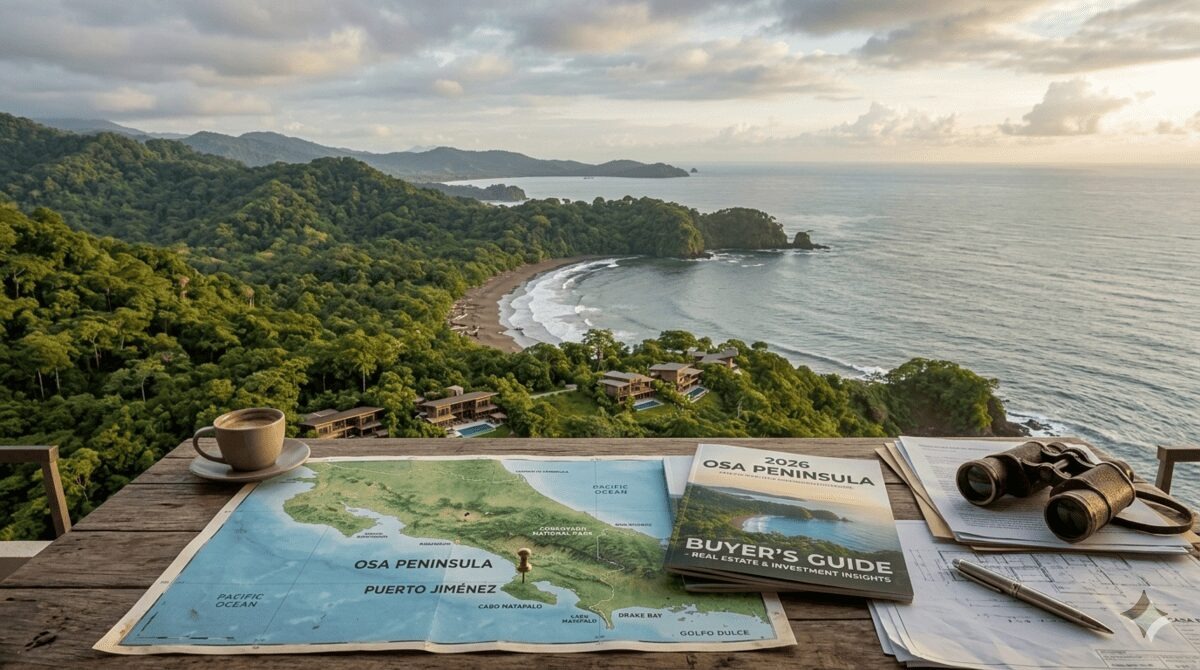
Costa Rica has long attracted foreign buyers with its political stability, natural beauty, and one of the most straightforward foreign ownership frameworks in Latin America. But straightforward does not mean simple. Costa Rica property laws involve a layered system of title types, registry verification, maritime zone regulations, and municipal zoning that can trip up buyers who skip the groundwork. Whether you are looking at jungle parcels in the Osa Peninsula, a beachfront lot near Carate, or a home in Puerto Jiménez, the legal framework governing your purchase is the same.
Understanding Property Ownership Rights in Costa Rica
Can Foreigners Own Property in Costa Rica?
Yes. Costa Rica grants foreign nationals the same property ownership rights as citizens. There are no restrictions based on nationality, residency status, or visa type. A tourist on a 90-day entry stamp can legally purchase and hold titled property in their name.
This is not the case across much of Latin America, where foreign ownership is restricted, capped, or routed through local partnerships. Costa Rica's open ownership framework is one of the primary reasons it has attracted significant international real estate investment over the past four decades.
That said, ownership rights apply specifically to titled (fee simple) property registered in the National Registry. A separate and more restricted framework governs concession land in the maritime zone — addressed in detail below.
The Osa Peninsula is home to Corcovado National Park — which National Geographic called "the most biologically intense place on Earth." Over 2.5% of the entire world's biodiversity exists within its 424 square kilometers. Properties bordering or near the park are subject to strict environmental buffer zone rules that directly affect what you can build — and how much usable land you actually have.
Equal Ownership Rights Compared to Citizens
Under the Costa Rican Constitution and property law, a foreign buyer who holds titled property has the same legal protections as a Costa Rican citizen. This includes:
- The right to sell, lease, mortgage, or bequeath the property
- Protection against unlawful seizure or expropriation without compensation
- Access to the Costa Rican court system to resolve disputes
- The ability to register the title in an individual name or a legal entity
The courts are independent and property disputes are adjudicated under established civil law. That said, legal proceedings in Costa Rica can be slow. Prevention — through thorough due diligence before closing — is significantly more effective than litigation after the fact.
Individual Ownership vs. Corporation Ownership
Buyers can hold Costa Rican property in one of two structures:
Individual ownership — The property is registered in your personal name in the National Registry. This is the simplest approach and works well for straightforward residential purchases.
Corporation ownership — The property is held by a Costa Rican Sociedad Anónima (S.A.) or Sociedad de Responsabilidad Limitada (S.R.L.). This structure is common for several reasons:
- Simplified transfer: selling the corporation transfers the property without a formal deed change
- Privacy: the corporation, not the individual, is the public record owner
- Estate planning flexibility
- Potential liability shielding for investment or rental properties
Both structures are legal and well-established. The right choice depends on your intended use, exit strategy, and tax situation. A qualified Costa Rican attorney should guide this decision before you sign anything.
Joint Ownership Structures
Costa Rica recognizes co-ownership (condominium of property) between two or more individuals or entities. Each co-owner holds a defined percentage interest. Decisions about the property — particularly sale or mortgage — typically require agreement from all co-owners, which can create complications if relationships change.
For married couples, Costa Rica also recognizes marital property rights. Foreign buyers who are married should clarify how title will be held and whether their home country's marital property laws interact with Costa Rican registration.
Types of Property Ownership in Costa Rica
Understanding the type of property you are purchasing is the single most important step in any Costa Rica real estate transaction. The legal framework, your ownership rights, and your risk profile differ substantially depending on which category applies.
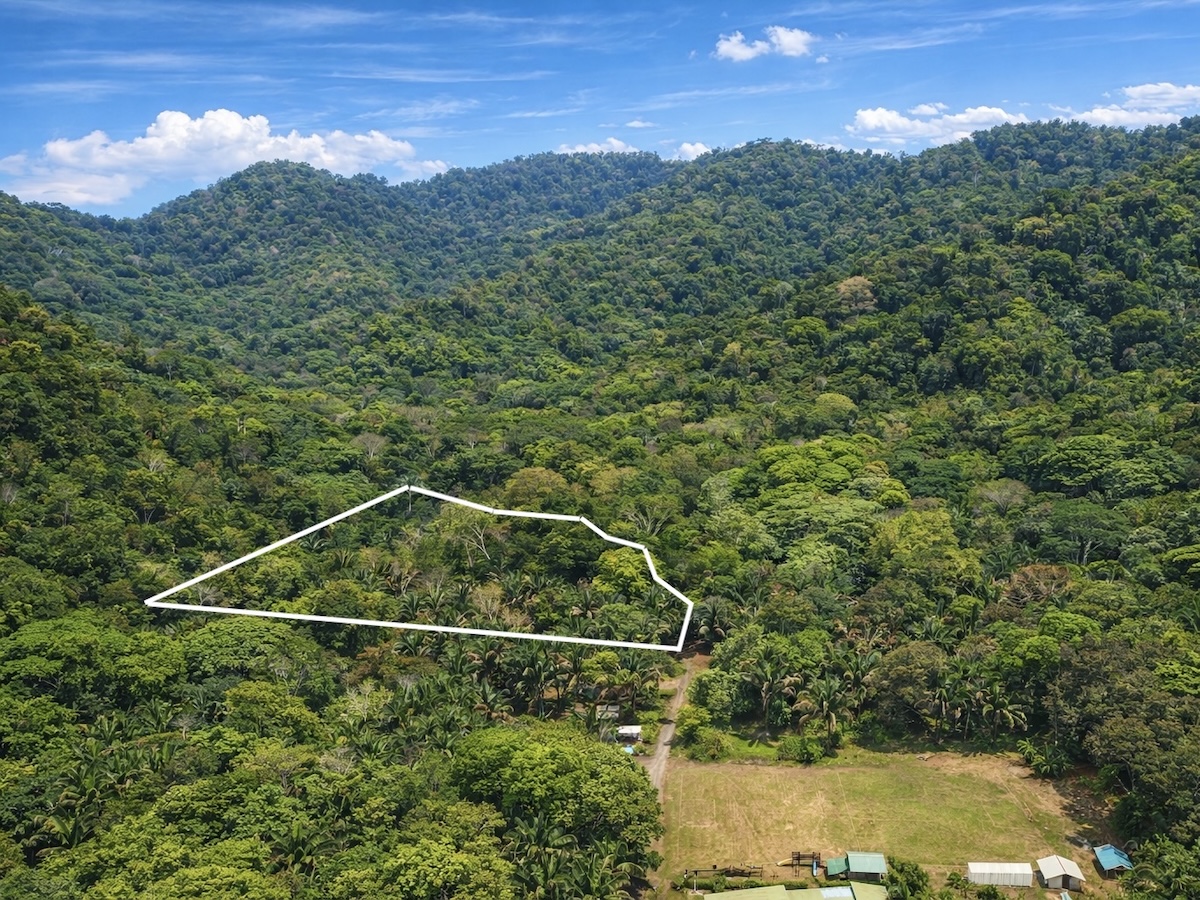
Titled fee simple property in the Osa Peninsula — the gold standard for foreign buyers seeking maximum legal protection.
Fee Simple (Titled) Property
Fee simple ownership — referred to locally as propiedad plena — is the gold standard. The property is registered in the National Registry (Registro Nacional), carries a unique folio real number, has defined boundaries from a registered cadastral survey, and can be freely sold, mortgaged, or transferred.
| Feature | Fee Simple Property |
|---|---|
| National Registry registration | ✅ Yes |
| Freely transferable | ✅ Yes |
| Mortgage eligible | ✅ Yes |
| Foreign ownership permitted | ✅ Yes — no restrictions |
| Concession required | ❌ No |
Corporation-Owned Property
The property itself remains fee simple — the ownership structure changes. The corporation holds the registered title. Transferring ownership means transferring shares of the corporation rather than executing a new deed. This structure requires maintaining the corporation in good standing, which involves annual government filings and a corporate transparency registry (Registro de Transparencia y Beneficiarios Finales — RTBF) filing that identifies ultimate beneficial owners.
Trust Structures
Fideicomiso (trust) arrangements are used less frequently in Costa Rica than in Mexico or Panama but are legally recognized. A bank or authorized trustee holds legal title on behalf of the beneficiary. Trusts are sometimes used in estate planning contexts or when financing is structured through a lending institution.
Agricultural and Development Properties
Agricultural land (fincas) may carry additional regulatory considerations — particularly around SETENA (environmental impact) approvals for development, water availability permits (ASADA or AyA concessions), and in some cases, restrictions tied to protected area buffer zones. In the Osa Peninsula, where Corcovado National Park and other protected areas are adjacent to private land, environmental restriction verification is especially critical.
The Costa Rica Property Title System
How Property Titles Are Registered
The National Registry (Registro Nacional) is the government institution that records all titled property in Costa Rica. Every titled parcel has a unique identifier called a folio real — a multi-part number that identifies the province, the property, and the rights associated with it (ownership, liens, mortgages, easements). The folio real is the starting point for any title search. All registered deeds, mortgages, legal encumbrances, and ownership changes are attached to this number and publicly searchable.
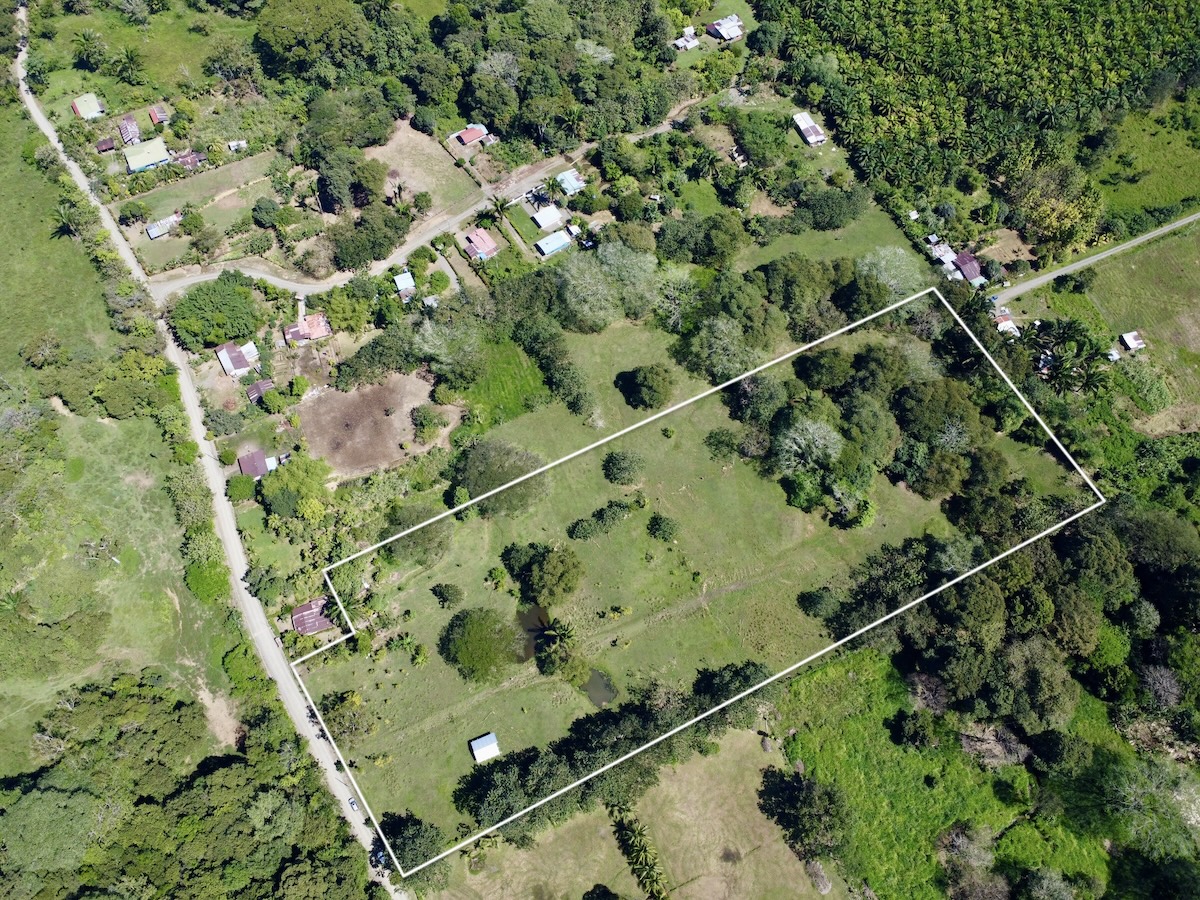
The Costa Rica National Registry — every titled property has a unique folio real number visible to the public.
National Registry Verification Process
A proper title search — conducted by a licensed attorney — verifies:
- Current registered owner — Confirms who legally owns the property and that the seller has the right to sell
- Liens and mortgages — Any outstanding debt secured against the property must be resolved at closing
- Legal encumbrances — Easements, rights of way, restrictions, or annotations attached to the title
- Ownership chain — Review of prior transfers to identify any historical irregularities
- Area consistency — The registered area should match the cadastral (survey) record
This search is not optional. There is no title insurance system in Costa Rica equivalent to what exists in the United States — due diligence is your protection.
Property Surveys and Cadastral Maps
The National Cadastre (Catastro Nacional) maintains the graphic record of property boundaries. Every titled property should have a registered plano catastral — a survey map stamped by a licensed topographer and registered with the Cadastre. Boundary disputes are among the most common property conflicts in Costa Rica. In rural areas — including many Osa Peninsula properties — physical markers may be absent or disputed. An on-site review with the registered plan is essential.
Identifying Title Issues Before Purchase
Common title issues discovered during due diligence include:
- Unresolved mortgages — Prior owners may have used the property as loan collateral
- Annotations (anotaciones) — Pending legal actions or disputes flagged in the registry
- Easements — Legal rights of passage or utility access that bind the property regardless of ownership
- Survey discrepancies — Registered area doesn't match physical reality
- Missing heirs — Properties inherited without proper legal transfer create chain-of-title problems
Any of these issues can be resolved — but must be resolved before you close.
Maritime Zone and Concession Properties
This section covers one of the most misunderstood areas of Costa Rica real estate law — and one of the highest-risk categories for uninformed buyers.

The Maritime Zone — Costa Rica's 200-meter coastal strip governed by Law 6043. The first 50 meters is public domain; no private title can exist there.
What Is the Maritime Zone?
Costa Rica's Maritime Zone Law (Ley sobre la Zona Marítimo Terrestre, Law 6043) defines a protected 200-meter strip measured from the mean high tide line along the entire Costa Rican coastline.
| Zone | Width | Status |
|---|---|---|
| Public Zone | First 50 meters from high tide | Inalienable public domain — no private ownership possible |
| Restricted Zone | 51–200 meters from high tide | Private use permitted only through government concession |
No titled (fee simple) property can exist within the first 200 meters of Costa Rica's coastline. What is sold in this zone is a concession — a government-granted right to use the land, not ownership of it.
Despite having some of the most coveted coastline in Central America, the Osa Peninsula has comparatively few active beachfront concessions — largely because large sections of its coastline fall within or directly adjacent to national park and wildlife refuge boundaries. This means the supply of legally buildable beachfront land in the region is genuinely constrained — a factor that influences long-term value for titled properties with beach access or views.
Restricted Zone Rules
Concessions in the restricted zone are granted and administered by the municipal government (municipalidad) in coordination with the Costa Rican Tourism Institute (ICT). Key rules:
- Foreigners who are not permanent residents cannot hold a concession in their personal name. A minimum two-year continuous residency is required.
- Concessions can be held by Costa Rican corporations in which foreigners are shareholders — but no individual foreign shareholder may hold more than 49% of shares in a concession-holding corporation.
- Concessions are granted for a defined term (typically 5–20 years) and must be renewed.
- Concession rights can be transferred, but the transfer requires municipal approval.
Concession Ownership Explained
When you purchase a property in the restricted zone, you are purchasing the existing concession rights — not the land itself. The transaction involves transfer of shares in the corporation that holds the concession, verification that the concession is active and current on municipal fees, and confirmation of permitted uses (residential, commercial, tourism).
Risks and Limitations Buyers Must Understand
- Non-renewal risk — The municipal government can decline to renew a concession
- Government expropriation with limited compensation — As the underlying land is public, compensation covers improvements only
- Financing difficulty — Most banks will not mortgage concession properties
- Resale limitations — The 49% foreign shareholder rule can complicate future sales
- Fee arrears — Unpaid municipal concession fees can result in cancellation
Many reputable Osa Peninsula properties for sale are titled inland parcels with ocean views or beach access via easement — without the complications of concession land.
Due Diligence Requirements Before Closing
Due diligence in Costa Rica is a comprehensive legal, environmental, and practical investigation that should be completed before you commit purchase funds. A licensed Costa Rican real estate attorney should lead this process.
Legal Review
- Full National Registry title search (folio real history)
- Lien and mortgage verification
- Encumbrance and easement review
- Corporate standing verification (if applicable)
- Concession status confirmation (if applicable)
- Seller identity and authority to sell
Registry Search
- Mercantile Registry — Verify corporate standing, shareholder structure, and legal representative authority
- RTBF — Confirm the corporation's beneficial ownership registry is current
- Judicial Registry — Check for pending litigation involving the seller or the property
Municipal Verification
- Use of land (uso de suelo) — Confirms what the property is legally permitted to be used for
- Municipal tax current status — Ensure no outstanding property tax arrears
- Building permits — Verify any existing structures were built with proper permits
Environmental Restrictions
Costa Rica has some of the most robust environmental protections in the Western Hemisphere. For buyers looking at Osa Peninsula land for sale, environmental due diligence is particularly critical given the region's proximity to Corcovado National Park.
- SINAC buffer zone restrictions — Properties within 500 meters of certain protected areas may face development limitations
- SETENA environmental impact requirements — Development projects above certain thresholds require assessments
- Wetland and forest restrictions — Clearing primary forest or wetlands is illegal
- River and stream setbacks — Buildings must maintain minimum distances from waterways
Water Availability Verification
Before purchasing any rural property, confirm the legal water source (SENARA, ASADA, or municipal), permit status, available volume, and dry season reliability. Properties without confirmed water access or permits can be nearly impossible to develop.
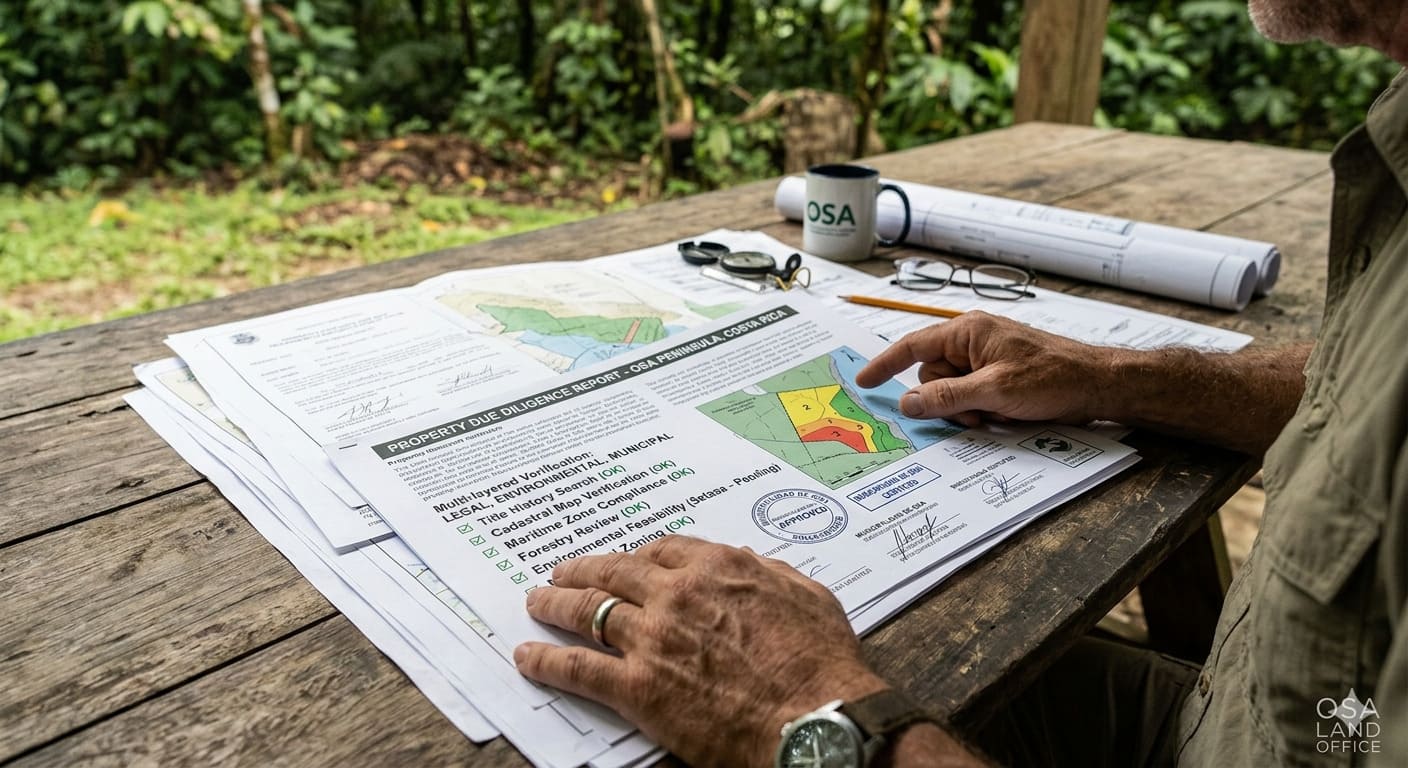
Due diligence in the Osa Peninsula is multi-layered — legal, environmental, and municipal verification are all required before committing funds.
Property Transfer Process
Purchase Agreement
The formal process begins with an Opción de Compra (Option to Purchase) or Compromiso de Compraventa (Purchase Agreement) — a binding contract establishing sale price, deposit amount (typically 10%), closing timeline, due diligence contingencies, and conditions of sale. This document should be drafted or reviewed by your attorney. The deposit is typically held in escrow.
Escrow Services
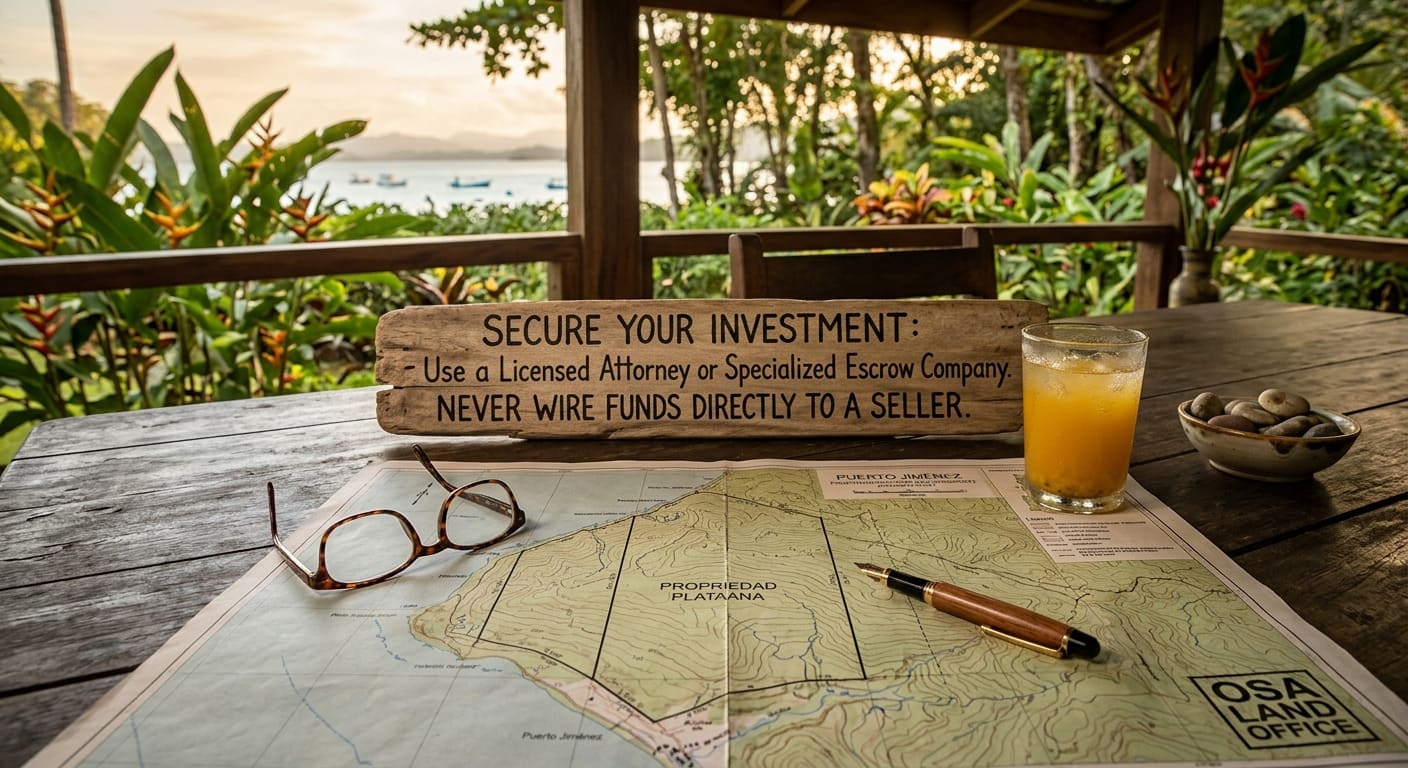
Costa Rica does not have a mandatory escrow system, but reputable transactions use an independent escrow agent — typically a licensed attorney or specialized escrow company — to hold funds until all closing conditions are met. Never wire purchase funds directly to a seller or unknown party.
Closing Procedures
Costa Rica real estate closings are conducted by a Notary Public (Notario Público) — licensed attorneys with specific government authority to execute public deeds. The closing involves:
- Execution of the transfer deed (Escritura de Traspaso) before the Notary Public
- Payment of transfer taxes and fees
- Submission of the deed to the National Registry for registration
- Registration of the new owner in the folio real
Registry processing takes 2–8 weeks after closing. During this period the deed is pending registration (en proceso) — the buyer has legal ownership, but the registry has not yet updated.
Registration of Ownership
Once the National Registry processes the deed, the folio real is updated to reflect the new owner. At this point the transfer is fully complete and the buyer's name (or corporation name) appears as the registered owner in the public record.
Taxes and Legal Fees
Understanding the full cost of acquisition — beyond the sale price — is essential for accurate budgeting.
| Tax / Fee | Rate | Notes |
|---|---|---|
| Transfer Tax | 1.5% | Paid to government at closing |
| National Registry Stamps | ~0.5% | Calculated on declared value |
| Notary Fees | 1–1.5% | Negotiable; regulated by fee schedule |
| Legal Fees (Buyer's Attorney) | 1–2% | Separate from closing notary |
| Total Estimated Closing Costs | 3–5% | Of purchase price |
Luxury Home Tax Considerations
Costa Rica imposes an annual luxury property tax (Impuesto Solidario Especial) on residential properties with a construction value above a set threshold (adjusted annually — approximately ₡133 million / ~$250,000 USD in construction value as of 2025). Buyers of high-end homes should factor this annual obligation into their ownership budget. For a full breakdown, see our Costa Rica property taxes and financing resource.
Common Legal Mistakes Foreign Buyers Make
Years of working with international buyers in the real estate Puerto Jiménez market and across the Osa Peninsula reveals consistent patterns in the mistakes that cost buyers money, time, and in some cases, the property itself.
Puerto Jiménez — the main town and commercial hub of the Osa Peninsula — has a population of roughly 7,000 people, yet the surrounding real estate market attracts buyers from over 30 countries annually. The ratio of international buyers to local population is among the highest of any rural real estate market in Central America, which is why working with an agent embedded in the local market — not operating remotely — matters more here than almost anywhere else in Costa Rica.
Buying Without Due Diligence
The most common and most costly mistake. Some buyers — particularly those purchasing in cash and eager to close quickly — skip or abbreviate the due diligence process. A missed lien, unresolved annotation, boundary dispute, or environmental restriction discovered after closing becomes the buyer's problem. There is no equivalent to title insurance in Costa Rica. Due diligence is your only protection.
Misunderstanding Concession Land
Buyers who don't understand the maritime zone framework sometimes purchase concession property believing they are buying titled fee simple land. The distinction is fundamental. Always ask your agent and attorney to confirm the title type. For buying land in Costa Rica, this distinction is foundational.
Ignoring Access Rights
Properties in rural Costa Rica — particularly jungle and mountain parcels — may not have legal road access. A property accessible by a dirt track does not automatically have a legal right of way over that track. Without a registered easement or public road frontage, the property may be landlocked in a legal sense. Always verify that your property has registered access before closing.
Failing to Verify Utilities
Rural properties in the Osa Peninsula and surrounding areas may have no connection to municipal water, electricity, or wastewater infrastructure. Confirm electrical service availability (ICE grid or solar), water source and permits, and whether any permits or concessions are in place for the water supply.
Planning to Buy in the Osa Peninsula or Puerto Jiménez?
Get our free 2026 Costa Rica Buyers Guide — built for international buyers navigating Southern Costa Rica investment properties, titles, and the closing process.
Get the Free Buyers GuideOsa Peninsula & Puerto Jiménez: Real Estate FAQs
Four questions that rarely get answered in the generic "Costa Rica real estate" content world — geo-specific, data-grounded, and directly relevant to buyers targeting the Southern Zone.
It's not just agent talk — but the data requires context. The Osa Peninsula and Puerto Jiménez don't have an MLS system, so aggregate appreciation figures don't exist the way they do in the U.S. or Canada. What does exist is a well-documented pattern: properties that traded in the $150,000–$350,000 range in the 2012–2016 period have in many cases resold in the $280,000–$600,000 range through 2024–2026, particularly titled parcels with ocean views, beach access, or eco-lodge development potential.
The structural driver is supply constraint: titled land in the Osa is finite, surrounded by protected areas, and cannot be replicated. The demand driver is growing: the NY Times listed Costa Rica as a top travel destination for 2026, and post-pandemic relocation interest in Southern Costa Rica has been measurably higher than the 2015–2019 baseline. The risk factor is liquidity — the market is thin, and exit timelines are longer than in larger markets. Buyers should treat Osa Peninsula real estate as a 5–10 year hold at minimum.
Yes, short-term rental is legal in Costa Rica and is a common use case for Osa Peninsula and Puerto Jiménez investment properties. However, "legal" involves more than just listing on Airbnb. To operate a short-term rental property in compliance with Costa Rican law, you need: a tourism declaration with the Costa Rica Tourism Institute (ICT), a patent (business license) from the local municipality (Municipalidad de Golfito for most of the Osa), registration with Hacienda (the tax authority) for income reporting, and compliance with health and safety regulations under the CCSS and Ministry of Health.
The property must also have a legal use classification (uso de suelo) that permits tourism or commercial activity — not all residentially-classified properties qualify without a zoning amendment. Buyers purchasing specifically for rental income should verify the uso de suelo during due diligence and confirm that the ICT tourism registration path is open for that specific parcel before closing.
Higher than most buyers expect — and more common than sellers disclose. In rural areas of the Osa Peninsula and around Puerto Jiménez, a significant percentage of residential construction was built without municipal permits (permiso de construcción) or SETENA environmental clearance. This creates several categories of risk for a buyer.
First: you inherit the liability. An unpermitted structure can be subject to a demolition order from the municipality or SETENA at any point after you close — you cannot retroactively blame the prior owner. Second: legalization (regularización) is possible but not guaranteed. The process involves bringing a licensed engineer and attorney to assess whether the structure can be brought into compliance, paying back-permit fees and fines, and navigating a municipal approval process that can take 6–24 months. Third: insurance and financing impact. Unpermitted structures cannot be insured through INS (the Costa Rican state insurer), which affects both your risk exposure and any future buyer's ability to finance or insure the property. During due diligence on any improved property — particularly homes for sale in Puerto Jiménez — require the seller to produce the original building permits before you release the deposit.
The national legal framework — the National Registry, the Maritime Zone Law, the transfer tax structure, the due diligence requirements — is identical across all Costa Rica regions. The difference lies in regional execution, infrastructure, and risk profile.
Guanacaste (Tamarindo, Nosara, Playa Flamingo) has a more developed real estate infrastructure: more active concession properties, more established title histories on coastal parcels, more foreign buyers and therefore more attorney experience with international transactions, and more developed access to municipal services. The Central Valley (San José metro) has the most standardized market, easiest utility verification, and most established legal precedent on property disputes.
Southern Costa Rica — the Osa Peninsula, Puerto Jiménez, Uvita, Dominical — trades lower infrastructure development for lower price-per-acre, higher scarcity value on truly remote titled land, and proximity to protected areas that will never be developed. The due diligence requirements are more demanding (environmental restrictions, water verification, access rights in remote parcels) and require attorneys and agents with specific regional experience. The upside: a 98-acre titled gulf coast parcel near Puerto Jiménez is a different asset class than anything available in Guanacaste at the same price point. See current Osa Peninsula real estate listings to understand the current inventory.
Costa Rica Property Law FAQs
Standard questions on Costa Rica property laws for foreign buyers.
Not in the traditional fee simple sense. The first 50 meters from the high tide line is inalienable public land. The next 150 meters (the restricted zone) can be used under a concession, but foreigners without permanent residency cannot hold a concession in their personal name — only through a Costa Rican corporation with no more than 49% foreign shareholder interest. Many buyers choose titled properties that sit beyond the 200-meter maritime zone boundary, often with ocean views and beach access via easement.
No. Any foreign national can purchase titled property in Costa Rica regardless of residency status. Residency is only relevant for holding a concession directly in your personal name.
From signed purchase agreement to completed National Registry registration, typically 6–12 weeks. The closing itself (deed execution) can happen within days once due diligence is complete. Registry processing of the new deed typically takes 4–8 weeks after closing.
The folio real is the unique identifier assigned to every titled property in Costa Rica's National Registry. It is the primary reference number used in all registry searches, deed recording, and title verification — the property's legal fingerprint.
Costa Rica imposes a capital gains tax of 15% on the profit from the sale of real estate. The cost basis can be adjusted for improvements and acquisition costs. There are specific exemptions for primary residences under certain conditions. Tax law in this area has been evolving since 2019 — consult a Costa Rican tax attorney before selling.
Article 45 of the Costa Rican Constitution guarantees equal rights and protection of private property be it owned by nationals or foreigners. Foreigners can own titled land outright in their personal name and live in Costa Rica part-time on a tourist visa. Forming a Costa Rica corporation is an option often recommend by lawyers but is over sold as a preferred way to hold title. Keep it simple has it’s merits. If liability is a concern you can get an inexpensive, general liability insurance policy for the property.
Unpermitted construction creates liability for the buyer. Structures built without municipal permits can be subject to fines and demolition orders. In some cases, permits can be legalized post-purchase (regularización), but this involves time, cost, and no guarantee of approval. Always verify permit status during due diligence.
Working with a local specialist in Puerto Jiménez — regional expertise covers environmental restrictions, water rights, and local property title nuances that outside agents miss.
Working with an Experienced Local Specialist
Costa Rica property law is navigable — but it rewards preparation and penalizes shortcuts. The framework protecting foreign buyers is genuinely strong: equal ownership rights, a public registry system, and an independent judiciary. What it lacks is the safety net infrastructure of some other markets — no mandatory title insurance, no standardized escrow requirements, no government-backed buyer protection programs.
That gap is filled by two things: qualified legal representation and an experienced local real estate specialist who understands the specific market you are buying into. The Osa Peninsula real estate market — encompassing Puerto Jiménez, Matapalo, Carate, and the surrounding areas — involves additional considerations that general Costa Rica real estate knowledge does not cover. Environmental restrictions near Corcovado, water rights in remote areas, access to off-grid properties, and the specific character of local property titles all require regional expertise.
Explore current homes for sale in the Osa Peninsula, homes for sale in Puerto Jiménez, and Southern Costa Rica investment properties — or contact Jeff Lantz directly to discuss your specific goals.
Ready to Start Your Osa Peninsula Search?
35 years of on-the-ground experience in Puerto Jiménez and the Southern Zone. No remote agents. No generic advice.
Contact Jeff Lantz Directly